March 2007


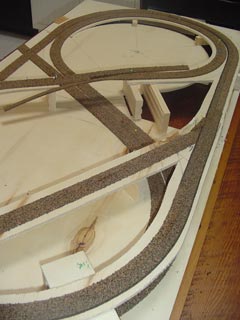
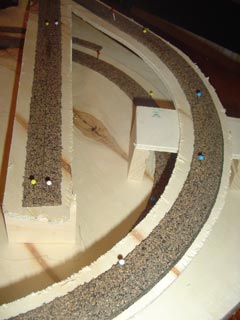
I decided to use traditional cork roadbed for my N scale layout as I was anxious to start laying track. However, if the given the choice I would have likely selected some other product as I found that cork roadbed has a number of issues.I installed the cork roadbed traditionally; applying a thin layer of glue on either side of the previously marked centre lines, and then pressing the roadbed into the glue and temporarily securing it in place with push pins. What I found as I was installing the roadbed was that the cork had a tendency to ripple on the tight radius curves, thus it became necessary to add a great number of pins to keep the roadbed flat. Likewise, when you split the cork into its respective halves, the ‘break’ edge doesn’t always come clean, leaving a coarse burr of cork that needs to be filed or sanded down. Also, as cork is quite dense, and as such it tends to transfer noise easily. This is likely no issue if you are constructing a railroad that used a sub roadbed of homasote or foam, but in my case I was applying the cork directly onto the plywood. I’ll have to wait and see how loud it gets!

Finally, when installing the cork on a curve, I found it easiest to install the roadbed on the inside of the curve first, as once installed, all I needed to do was form the outer piece along the first piece’s edge.

I managed to install the roadbed in two evenings ‘ I would have been one evening, but I ran out of push pins. I left a great deal of overlap at the bridge area as I have yet to decided what I’m using for a bridge!
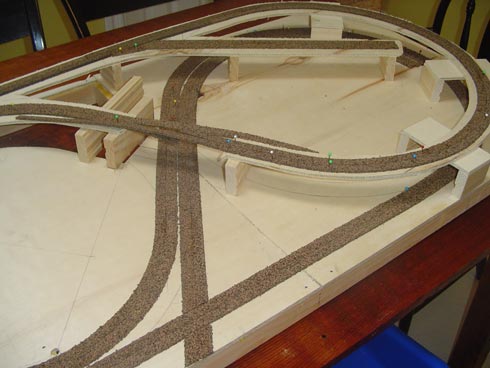
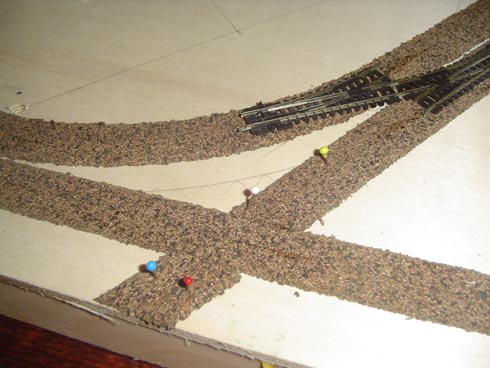
cork roadbed

roadbed2.jpg

cork roadbed roadbed4.jpg

With my trusty laptop nearby, I began laying out the basic curves and centrelines on my plywood base. I chose to use 1/4″ plywood underlay for several reasons. Firstly, it’s very clear, with few visible or rough knots. As well, the wood is very flexible, which is a bonus as I needed to construct 5% grades to connect the upper and lower loops. Finally, the plywood comes in four foot square sheets, which meant I could easily transport the plywood in my car.

After I had roughed in the basic curves, I checked the placement of the turnouts and the diamond to ensure that they would all fit. Surprisingly, my drafting of the track plan was fairly accurate, and I only needed to make small minor adjustments in order to fit all the components together.

sub0.jpg

Satisfied with the arrangement of the switches, I broadened the centerlines so that each of the sub-roadbed pieces would have a minimum width of about 3″. Next, I took a jigsaw and cut along each of the paths – being careful not to complexly remove the upper loop, so that the transition from the lower level to the upper level would be smooth. The flexibility of the plywood added a natural vertical easement which ensured that trains would gradually move onto the grade as opposed to running up a ramp.

With the basic shapes cut out, I constructed a simple wooden frame using 1″x2″ pine. I layed out the 2″x4″ frame and added stringers on 1″ centers. Ensuring that each joint had a good coat of glue, I nailed the frame together with some 1 1/2″ finishing nails. I didn’t bother to check the frame for square, as it was fairly flexible and could be shifted to fit the baseboard.

I applied another generous coat of glue to the perimeter of the frame as well as the top of the stringers, and set the baseboard atop it. I shifted the frame until its corners were square with the plywood, and then nailed the entire assembly together with finishing nails.

Once the glue had dried, I used assorted scraps of lumber as risers to elevate the upper loop. After checking and re-checking the grades and slopes, I hot-glued the risers in place. The upper loop needed to sit atop of the bottom loop and hidden staging, so I cut some girders from the leftover plywood, allowing the sub roadbed to be supported about the lower loops with very minimal obstruction.

Once I was satisfied with the overall construction, drizzled additional glue into any joint that I thought could use additional strength, and tacked in a few finishing to keep things tight. I left the entire assembly to dry overnight on a flat surface (in this case the kitchen table) to ensure I didn’t wind up with a potato-chip baseboard thanks to an uneven surface.

sub1.jpg

newsmalllogo.gif The NES is a small, modern-day freelanced railroad set in rural Southwestern Ontario, Canada. While not specifically based on any particular railroad, the NES does owe its genesis to the inspiration gained from studying the Guelph Junction Railway ‘ a small branch line operation managed by the Ontario Southland Railway.

In designing the NES, I made a list of some practical features I wanted, as well as a list of design elements I wished to include. As this is my first layout, (aside from my childhood 4′x8′) , and my first attempt at N scale, I wanted the layout to be fairly small and portable, as I didn’t really have a ‘train room’. As well, I wanted to take advantage of the small collection of engines, rolling stock, and track work that I had collected over the past five years. Finally, I wanted the project to be ‘hobby shop independent’ ‘ meaning that any construction techniques I used, as well as scenery methods, could be done without constantly running to the hobby shop for more supplies. I wanted to do the vast majority of work with only ever having to visit the local hardware/dollar store.

For my n scale model railroad’s design, I wanted a plan that was continuous run, modeled a plausible railway design element, favoured scenery over track work, and could be divided into two separate scenes for scenic diversity. As well, I wanted to try to capture the essence of the Niagara escarpment and its surroundings in early winter.

Considering these sets of criteria, I managed to develop the following 2′x4′ layout. The design is a basic folded dog bone, with one small industry as well as an interchange, some hidden staging, and a small town. Overall, the plan allows for a decent amount of scenery, and while continuous run, should look less toy like with the tunnels and the view block.

While I was at it, I decided that I best design a herald for the railway to help set the mood. I settled on Niagara Escarpment System for the layouts name, and based the logo design on the East Troy Electric Railroad’s insignia.

nes.jpg

neslogo.jpg