October 2007


I’ve spent the last few weeks slowly building some structures for the NES. I am new to scratch building, so I’ve spent a good deal of time learning some of the different techniques. The NES doesn’t have any industry buildings, less one, so the majority of mt time has been spent designing houses for the town. I had considered purchasing some small-town structures for the layout, but after pouring over various catalogues and websites, I decided that most of the structures were to either too ‘cute’ or too new to suit my needs. I was looking for simple, straightforward buildings.

Thus, I ordered a series of windows and door from Tichy Trains, and picked up a few packages of styrene from the LHS and set to work building. The first two structures I assembled were based on the initial plan I had come up with earlier this year. Satisfied with the results, I started creating structures based on some of the houses in my neighbourhood.

The structures are still incomplete as I have yet to add shingles, finish the painting and add some weathering. Overall I’m quite pleased with how each building turned out, particularly my freelanced signal tower and Cape Cod cottage. The photographs seem to have revealed many flaws that weren’t apparent during construction, which would typically bother me, but I’m becoming more convinced that the optimal viewing distance for N scale could be a great as a few feet – at which point these defects disappear – I may not correct them in favour of starting new projects.

house3.jpg

house4.jpg

house1.jpg

house2.jpg

house5.jpg

house6.jpg

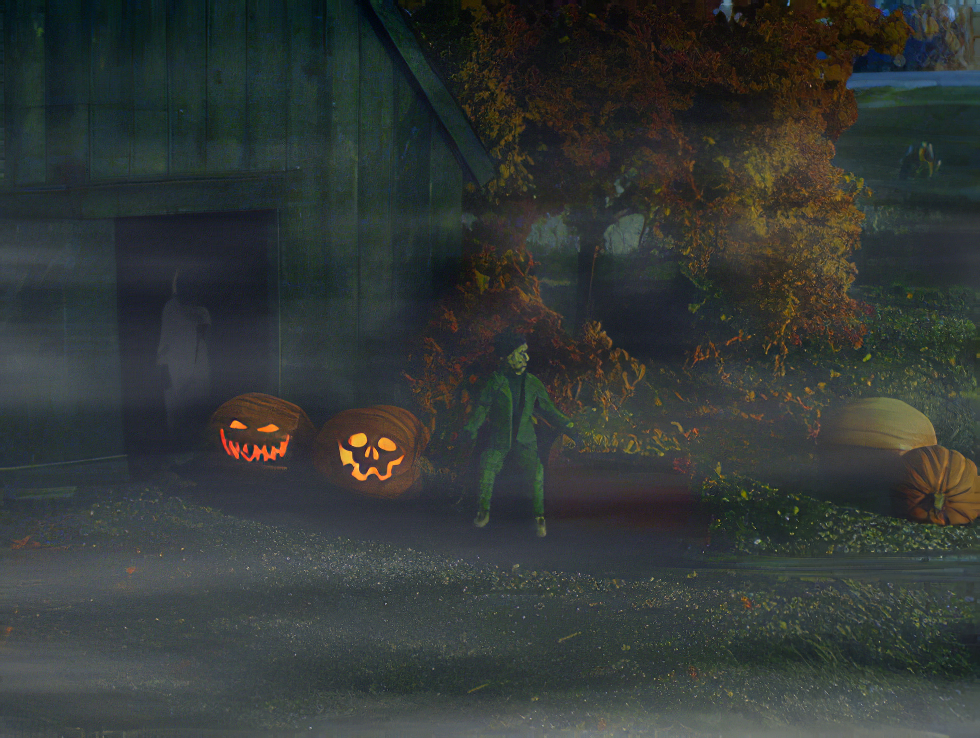
A reader left a very pointed comment that asked a very good question ‘ ‘how does Pete unload the pumpkins?’ I went hunting to see if I could find some 1/32 tractors etc. But they were rather costly ‘ at least for this project’s budget. I decided that Pete, being a frugal farmer, would have likely rigged some sort of ‘block-n-tackle-hoist-thing’ from junk lying around the barnyard, so I decided to do the same. Using a pencil, a bamboo skewer, old n scale wheels and some scrap styrene, I ‘imagineered’ a yard hoist. The boom on the hoist actually swings, and the line will pull through the pulley. It’s not the front-end loader that I envisioned the farm having, but it will do the job!


I’ve spent the last few months trying to develop a technique for modeling fall trees that is effective, easy and cheap. The large maple tree I modeled for my Pete’s Pumpkins layout confirmed that I had finally settled on a process that was simple and effective, and I’ve started adding some hardwoods to the one corner of the Niagara Escarpment System. The key was in finding suitable dried floral stems that best represented the branch structure of the native deciduous trees. I found many samples that looked good for branches but lacked decent trunk structures, until I noticed a package of cocktail straws at the dollar store!

The process is as follows:

  • Trim a number of stems from the original floral sprig and insert them into the cocktail straw creating the desired tree shape
  • Carefully apply heat (in my case a candle) to the straw until it starts to melt, and then quickly roll it back-and-forth between your fingers to create a tight, wrinkled trunk
  • Trim the tree to shape
  • Apply a coat of thick acrylic tube paint to the base of the branches to smooth any rough areas and fill the holes at the top of the trunk
  • Spray the entire tree with flat black/grey/brown paint
  • Mist the head of the tree with light coats of yellow paint and immediately apply suitably coloured ground foam
  • Add successive coats of hairspray and ground foam until the desired density and colour is achieved
  • Overspray the tree with quick blasts of red oxide primer to add colour variation
  • Touch-up with the trunk by dry-brushing highlights onto it

The set of trees seen in the following photo took two evenings to build at an average of about a half-hour per evening.

ftree1.jpgftree2.jpgftree3.jpgftree4.jpgftree5.jpgftree6.jpgftree7.jpgftree8.jpgftree9.jpgftree10.jpgftree11.jpg

Soon after I submitted the WHR trackplan to the nscale.net forum I received some constructive criticism on the design from a helpful member. His criticisms were as follows:

  • staging is too limited / small
  • too much rail-fanning ‘ not enough industry
  • no passing sidings

(He also noted that the yard needed work to be functional – something I struggle with as I have little understanding of how railroads operate.)

I took note of his ideas and have come up with this slight variation.

whr_revision1.jpg

whr_stage_revision1.jpg

With the backdrop in place and the basic colours of the layout defined, it was now time to start adding some trees and shrubs.

I built the shrubs using some unnamed dried floral product I purchased at Walmart a few years ago. I snipped bush-sized stems from the main stalk and glued the sprigs together using hot-glue; rolling the sprigs between my fingers as the glue began to cool. Working in batches of 10, I systematically spray-painted the sprigs flat brown, dipped them into diluted white glue, and then sprinkled on various colours of ground foam. I finished by spritzing each bush with a generous amount of hair spray, and then stuck each bush into holes in a cardboard box to dry.

While waiting for the bushes to dry, I began construction on the large tree that would grow beside the barn. A few weeks ago I noticed that the dying lilies in our garden left long woody stems with forked ends that could work as a basic tree armature. I gathered up as many stalks as I could find and began hot-gluing them together until I had created a basic tree armature. I then created branches by combing a few sprigs of the dried weeds in the same fashion that I made the bushes, and then attached each of these sprigs to the basic armature of the tree using hot-glue ‘ working my way from the center of the tree outward. Once I was happy with the general shape of the tree, I again applied a coat of flat brown spray paint and allowed the tree to dry. Once dry, I applied successive coats of hairspray and ground foam until I had built up the branches to resemble leafy bows. I then misted the entire tree with a few blasts of red oxide primer to add some colour variety.

Once everything was dry, I punched holes in the scenery using an awl, and planted the shrubs with a dab of white glue. For the tree, I drilled a larger hole near the barn, filled it with hot glue and pressed in the tree until the glue had set.


Even though I’m in the process of finishing my two other layouts ‘ Pete’s Pumpkins and The Niagara Escarpment System ‘ I’m eager to start my next layout. I’ve learned a lot from these two layouts, but they are not without their drawbacks. One of the things I’ve come to understand that taking the time to develop a suitable track plan is paramount for the overall success of the layout. As such, I decided to approach this layout design by referencing the prototype

I also decided that I would try designing a railroad after the WHR prototype as many of the design decisions have already been made ‘ industries, locomotive rosters, geographical landmarks etc.

As I’ve been fortunate enough to have amassed a good deal of information about the WHR, I was comfortable designing a railroad that closely resembled the prototype, however my limited space and budget make it more difficult to design a pleasing track plan as one must selectively compress industries and landmarks. Likewise, limited space prohibits long trains, vast yards, and large rosters.

In an attempt to simplify the process, I developed the following set of guidelines:

  • the layout needs to be portable, so an around-the-wall design is out
  • maximum space is about the size of a door (30×80)
  • I prefer rail fanning over switching so the layout should allow for continuous running
  • Hidden staging is a must
  • The design should capture the flavour of the prototype

I developed several ‘concept’ plans but was unhappy with the results as my continuous run criteria complicated the design. Frustrated with progress I returned to Google maps to see if I could find anything of interest. As stated earlier, most of the images of Nova Scotia are of very poor quality so tracking the WHR mainline was impossible. However as I followed the railroad east, the images improved and I discovered Windsor Junction. Windsor Junction connects connect the quarries on the north end of the province with the south, and offers an interchange for the westbound line to Hantsport. While I didn’t like the idea of modelling a wye, I couldn’t deny that it could be a perfect solution to my design dilemma.

Thus, here is the first incarnation of the new Windsor Gypsum Railway track plan. The layout is 34″x76″ with a minimum radius of 9″. I’m not yet happy with the yard configuration, and I haven’t considered where I might add some buildings, however I’m pleased with the overall concept.

wgr1.jpg

wgr2.jpg

n709818372_163664_14601.jpgn709818372_118289_7967.jpgn709818372_166857_2302.jpg

wgr3.jpg

The first test application of the backdrop revealed a few issues I wanted to resolve. Firstly, as the image I was using was small it didn’t scale well when printed large ‘ the image quality degraded too much. Secondly, the colour of the backdrop wasn’t quite right.

I purchased a small copy of this image from istockphoto.com for $1.00. I colour-corrected the image such that it lost its ‘peach’ hues, and then I re-coloured the fields so that their colours more closely matched the ground cover I had applied. Finally, I scaled the image to the appropriate size and subtly applied paint daubs filter ‘ just enough to correct the graininess of the image. I cut the image to fit, and attached it too the hardboard using rubber cement.

The first test application of the backdrop revealed a few issues I wanted to resolve. Firstly, as the image I was using was small it didn’t scale well when printed large ‘ the image quality degraded too much. Secondly, the colour of the backdrop wasn’t quite right.

I purchased a small copy of this image from istockphoto.com for $1.00. I colour-corrected the image such that it lost its ‘peach’ hues, and then I re-coloured the fields so that their colours more closely matched the ground cover I had applied. Finally, I scaled the image to the appropriate size and subtly applied paint daubs filter ‘ just enough to correct the graininess of the image. I cut the image to fit, and attached it too the hardboard using rubber cement.