December 2007
Monthly Archive
Mon 31 Dec 2007
Posted by Model Railroader under
Structures[4] Comments
One of the challenges I’ve encountered in the past is trying to find and easy way to design architectural models on the computer. I’ve worked with several 3D programs as well as an assortment of CAD suites, but for the simple task of creating basic wireframe drawings for model railroad structures, I’ve settled on using Adobe Illustrator. I find that Illustrator allows me to develop drawings quickly, as well as create an interactive reference that I can use during construction. I’m not going to go into a full-fledged tutorial on how to use Illustrator – like other programs of its ilk it does have a average/steep learning curve, and isn’t the cheapest program available – it’s intended for use in the graphic design industry so the majority of individuals don’t have access to the program. For those who do have it and use it, here’s a quick outline as to how I create my scale drawings.
Step one: create a representative scale
While Illustrator can express all objects as imperial units, trying to design a full size structure using the program is impossible as the page margins are quickly exceeded by any 1:1 drawing. Instead, I’ve found that it’s easiest to use cm as a representative unit for feet. Ie. 3cm = 3feet. Thus, I start a new document using cm for the basic units and rulers.
Step two: express fractions as decimals
As every foot has 12 inches, it’s difficult to design components without first translating the measurements to decimal equivalents. To do this I use the following table.
1″ = 0.08cm
2″ = 0.17cm
3″ = 0.25cm
4″ = 0.33cm
5″ = 0.42cm
6″ = 0.50cm
7″ = 0.58cm
8″ = 0.67cm
9″ = 0.75cm
10″ = 0.83cm
11″ = 0.92cm
With this, a door that is 3′ x 6’8″ becomes 3cm x 6.67cm. Using this, I can specify exact measurement using the transform tool, as well as add two dimensions together easily.
Step three: scale to N
Once I have finalized my drawing, I reduce the overall size to 13.72% of the original to create a full-size N scale rendering. Because we are working in cm, the drawing has already been scaled down considerably – it now only needs to be reduced further to be an exact 1:160 rendering.
Step four: build with the computer
I now have the option to print the drawing at 100% and use this hard copy as a reference, or I can simply pull the drawing up on the screen of the computer and work with it as I build. I find the latter method easier as clicking on any aspect of the drawing will give me exact measurements expressed as cm. So in the case of my 60′ long feedmill, selecting the entire drawing (and referencing the transform tool) tells me that I need to cut the base of the structure 11.43cm long. In the case of the second decimal place, I typically round this measurement to the nearest decimal. Doing so does cause some inaccuracies in the build, but usually 1mm can be compensated for quite easily.
So there you have it. Again, for those unfamiliar with the program this will likely be a rather cryptic explanation. I hope that for those of you who do use Illustrator, this may offer an easier option for scratchbuilding then graph paper and pencils.
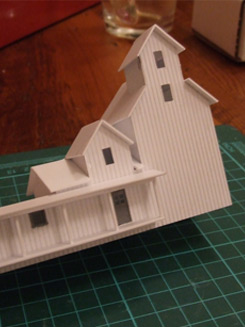
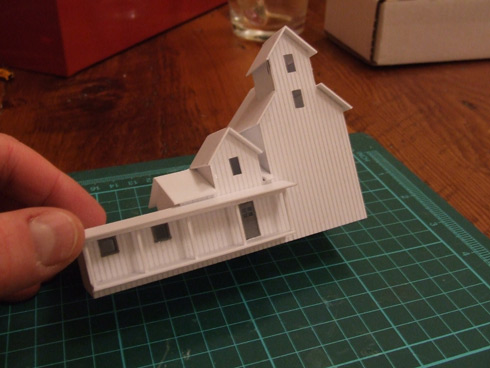
Based on the drawing I completed two evenings ago, here is the progress on the feedmill: I’ve managed to completely construct the basic structure. All that needs to be done now is add some paint and details.
Sat 29 Dec 2007
Posted by Model Railroader under
Structures[7] Comments
I’m really quite eager to start the next railroad, but I’ve promised myself I’ll finish this one. The remaining building I need to construct serves the spur on the autumn portion of the layout. I decided that a feed mill would be the most appropriate industry, so I went hunting for a few images. It didn’t take long before I happened upon this photo.
I reworked the photo in illustrator until I had come up with a scale schematic to work from. (*Note: most people don’t use Adobe Illustrator, let alone draft structures in them -this is something best left for CAD, however I do find illustrator fast, easy to use, and produces drawings with real measurements that I can work from.)
The draft is terribly incomplete – I just wanted to outline enough of the major architectural features for me to start building. I’ll add the details as I go along. I’m not too worried about creating an overly complex or highly accurate model – just a reasonable facsimile.

Thu 27 Dec 2007
Posted by Model Railroader under
Structures[2] Comments
With the arrival of my Tichy order I’ve started to make some progress on the NES. The first order of business was finishing the last structure for the town. I already had built and painted the little house, but until the windows arrived I was at a standstill. I managed to paint the windows and doors, apply a touch of weathering, plant some weeds and add a roof. Unfortunately I threw away my remaining shingles over the weekend (a delusional pre-Christmas cleaning tirade) and as I wouldn’t be able to print more until the second week of January I went hunting for a suitable alternative. I finally settled on some 320 wet/dry sandpaper. The roof lacks any definition in terms of the courses of shingles, but the texture and colour are right. One thing I’m still struggling with is the good ol’ three-foot rule. It strikes me that it would be virtually impossible to see the courses of shingles at 1:160 but many modelers elect to include them. I prefer my printed shingles, but this is a suitable stand it.
My fresh supply of windows also meant I was able to complete the little cabin I had built. Originally I built the structure for the town but wasn’t happy with the look – too rustic. I elected to set it off in a corner of the layout – no good reason for it – but I didn’t want to throw it away!
As for the cows; they were a stocking stuffer. My highly supportive wife always gets me a little ‘train’ something each Christmas, and the cows were one of her gifts. I decided that rather then let them collect dust, I’d add them. I wouldn’t have bought them, but she got such a kick out of seeing them on the layout I couldn’t say no. So, the NES now proudly boasts two Holsteins. Milk anyone?


Mon 24 Dec 2007
Posted by Model Railroader under
'Short-lines'1 Comment
What a pleasant surprise ‘ my order from the Tichy Train Group arrived ‘ one day before Christmas! I now have everything I need to finish the NES. I’m estimating that I need 20-30 hrs to complete the layout (yes, I know, a layout is never complete) and I would love to finish it over the next week ‘ before I return to work.
The two most pressing projects are to finish the town, and to design/build an industry for the autumn spur. I’m thinking I’ll build a feed mill ‘ or something similar. I’ve been browsing through images online and I think I have a sense of what I’d like. I’m not too worried about building an exact replica ‘ just something that captures the essence.
Anyway, thanks for visiting and offering your comments and support over the past year. I’ve made a number of new acquaintances in the past months, and I wish them, and everyone else, a Merry Christmas!
Wed 19 Dec 2007
Posted by Model Railroader under
Structures1 Comment
I’ve being trying to finish up the town on the NES however progress has been slow. I finally got an evening to work on another structure and things didn’t go as smoothly as planned. Firstly, shingling around the dormers proved to be quite challenging as it was difficult to make everything fit seamlessly. When I finally got the shingles to fit and I was happy with the result I managed to accidentally touch to roof with a paint covered finger – no amount of work would hide the mistake so I had to shingle the roof twice. Second, this building wasn’t as crisply made as the others so the weathering highlighted many mistakes and required some judicious ivy applications. The weathering also revealed that I had managed to construct some of the walls upside down – the siding was the wrong direction. This wasn’t highlighted until the weathering was applied as the ink/alcohol mix highlighted the error. Finally, when I started to glaze the windows I realized that I couldn’t access the dormers as they were permanently affixed to the roof!
While these are minor errors, they did highlight some important points about assembling structures – do get too far ahead of yourself! When I first started building this little house, I should have constructed the dormers separately, weathered them, installed the glazing and then applied the roofing. I had already learned a valuable lesson earlier in ensuring you paint doors and windows BEFORE applying them, otherwise you either need to brush paint them, or simply paint them the same colour as the rest of the structure.
As such, the cottage has far more ivy then I would have preferred. Oh well. Windows and door have been ordered so I should be able to build the last house and move onto the warehouse.

Wed 12 Dec 2007
Posted by Model Railroader under
Structures[4] Comments
Eager to ‘get out of town’, I’ve started a push to finish up my small residential community. While I’m not a big ‘super-detail’ fan, I do think there are some basic things that all structures need in order to blend then satisfactory into their surroundings – namely weathering. I didn’t want to spend too much time aging the buildings so I decided to settle on the technique I used here for all the buildings and call it a day.
As before, I applied a wash of rubbing alcohol/India ink to the structure using a soft brush and allowed the wash to flow into all of the nooks and crannies. I used a cotton swap to remove any excess and blot away any streaks. Happy with the overall effect, I again turned my attention to the windows. As before, I glazed the windows using some acetate, and added some blinds with regular bond paper.
I added some weeds around the base of the buildings. I find that often time modelers don’t really ‘ground’ their buildings, and an unrealistic gap is formed between the base of the building and the scenery that creates the illusion that the building is floating. Rather then attempt to add ground foam around the base of each house with a pair of tweezers after each house had been installed on the layout, I opted to glue weeds around the perimeter of each house before installing them. I brushed on a thin coat of white glue to the base of each structure and added some course ground foam.
I test fit each of the buildings, and added scenery material where necessary before soaking the entire area with wet water. I placed the building in their final locations and saturated everything with dilute white glue / water. The foam as the base of the buildings wicked up the glue and ‘pulled’ the base of the buildings into the scenery. I’ll need to wait for the glue to dry to see the results, but currently everything looks good.
Only one house and one warehouse left to build. I really should order more windows!


Sun 9 Dec 2007
Posted by Model Railroader under
Scenery[6] Comments
I’ve spent the last few weeks working on ways to make decent looking evergreens using scrub pads and bamboo skewers. There have been a number of articles outlining how to make trees using similar materials such as floor buffing pads, furnace filters etc., and the technique for each is virtually the same, but the product isn’t necessarily realistic. While a ‘green cone’ may remind us of a tree, it doesn’t mean it looks like one.
I’ve been fortunate enough to come across a few articles in the recent while outlining the importance of trying to capture the overall shape of a tree – too often we are content to put branches on a truck and declare the tree finished without actually referencing the ‘prototype’. With this in mind I set out to try to create a fairly reasonable facsimile of a black spruce.
(The black spruce is a tall, narrow evergreen tree common in Ontario. At the turn of the century they were typically planted in rows on farms to create wind-blocks, and are one of the tallest evergreen species found in southwestern Ontario. They are typified by their sparse drooping boughs and dark colour)
I came up with the following technique and managed to manufacture some fairly decent looking trees. Critically speaking, they are too dense and should be more airy, however I’m quite happy with their overall look, as well as their cost, less then 2 cent a piece!


I first started by separating a green kitchen scrub pad into 4-plys. Peeling the pad apart in easy the first time, but does take some additional care for the second pass.

I next cut out a long triangle from pad, roughly 1″ wide at the base, and then cut this into a series of successively smaller triangles.

I teased out the largest end of each triangle with my fingers to remove the visible corners, and then pushed each of the triangles onto the bamboo skewer, turning the skewer 90 degrees each time I added a triangle.

I coated all the boughs and the trunk with black spray paint and then liberally applied some sawdust. I stood the tree upright in a block of foam and adjusted the boughs as necessary. I let the tree dry for 15 minutes. (This is important as if you move to the next step before the tree has dried the weight of the paint/sawdust/foam will cause the boughs to sag too much and adhere to the trunk

I finished the tree by adding a second coat of black spray paint and then a dusting of green-grass fine ground foam. I over sprayed the entire tree with a bit more black paint to dull the colour a bit and then added one last sprinkle of ground foam ‘ from directly above the tree ‘ creating some highlights.
Once the tree was completely dry, I cut the trunk to the appropriate length using side cutters, and planted it using an awl.