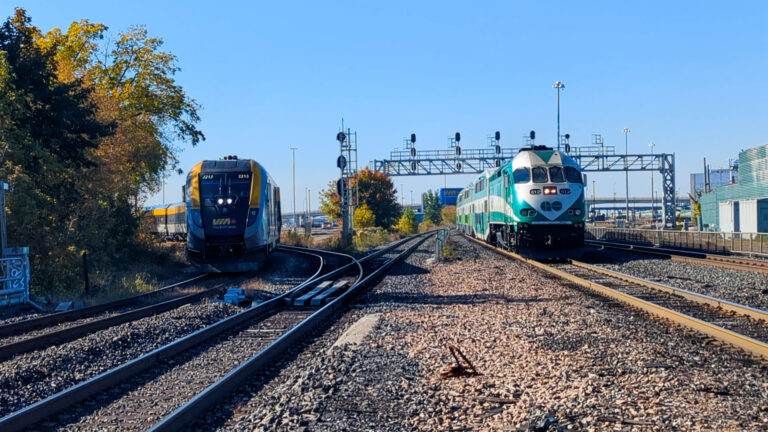
The WGR is progressing slowly – and that which is being done isn’t really worth a feature here. In an effort to maintain some sort of publishing regime, I’m going to start uploading a series of videos of the Windsor Hantsport Railway Company.
I want to extend a huge thank you to Kim “Grizzz” Little – an operator on the WHRC for sharing these videos with me. Grizzz is a class act, and I’d like to consider him a friend.
Progress has been steady and I’ve completed the basic structure for the first bridge. As mentioned, I’m attempting to pay better attention to non-train details – thus I’ve put a little more thought into this simple bridge then I would have in the past.
I’ve decided to freelance the bridge design based on local examples, as I haven’t any references for the ‘real’ bridge. Likewise, I’m not interested in building retaining walls brick by brick, so I’ve opted to model poured cement.
The deck and stringers for the bridge were built using styrene. I included all the stringers for prosperity’s sake, but didn’t worry about adding any details. As for the retaining walls, I decided to use balsa wood. While balsa does have a wood-grain texture that requires sanding, its bulkier dimensions simplifies the wall building process.
I built the wall off-site on a scrap piece of foam – affixing each of the walls to a sheet of paper taped to to the surface. I then braced the walls with some scrap balsa, again gluing everything to the paper base. I also reinforced each of the seams on the wall with bits of paper.
This technique is surprisingly strong, and once the glue had dried I was able to cut around the base of the walls without effecting their placement.
I did a quick test fit and everything looks good. I’ll need to bring the landscape out to meet the bridge, and I still need to finish wiring the track. I believe that I’ll apply several coats of paint and putty to the retaining walls to remove the ‘wood look’.
Before I can proceed much further in the layout I need to finish the wiring, weather the track, and install the concrete bridges for the highway. My last layout taught me that while trains are number one, it’s important to give roads/houses/industries and their elevations equal thought. I have seen (and am guilty of) adding roads as an afterthought – creating little more then a cow path through an unnaturally undulating landscape. Therefore, I’ve been making every effort to shape the roads and embankments as realistically as possible – or as realistically I can imagine.
This past weekend included a great deal of driving, so I had an opportunity to take a close look at the bridges and overpasses along the highway. While I couldn’t stop to measure each bridge, I was able to get a sense of the proportions and estimate the basic dimensions based on some known measurements.
For example.
basic car-lane width: 12′
sidewalk and shoulders: 4.5′
minimum width/clearance from centre of rails: 14′ (28′ total)
With this I was able to draft out the following guide. I haven’t bothered to finish it as all I really need is a basic reference. I’ll spend the next few evening building the first bridge based on this guide. As the basic dimensions are there, the end result should be fairly convincing. Here’s hoping…
Having completed the track I was eager to try running some trains. I had been rather cavalier when I installed the track work – not bothering to test each turnout etc., in favour of simply finishing the job. As such, I was eager to get trains running and see how I did.
The verdict? I managed to do a great job! Trains run great!
Granted, I needed to clean the track, file down the odd solder blob and clean the cursed foam shavings out from under the ties, but overall the trains ran well. I was so excited I shot some video for prosperity’s sake. I still have to wire the turnouts and cut some gaps in order to isolate the sidings, but that’s straightforward work that can be done as I start thinking about how to model the concrete bridges and retaining walls.
(I also spent some time finishing the basic scenery contours, and roughing in the overpass locations.)
Progress on the WGR has been slow of late, but I’ve managed to finally finish laying the track.
As mentioned in an earlier post, the switch machine dilemma was one factor responsible for the summertime pause. However, once I was able to finalize the switch machine design, progress ramped-up considerably.
I’ve yet to wire each of the turnouts and fix-up some of the roadbed, but the track is done and initial tests suggest that everything is running smoothly.
I feel it is worth mentioning that I modified my track laying technique for the WGR. I have traditionally used clear latex caulking as a track adhesive (impressed by the adhesion and ease of use) however the process of applying adhesive before track can get rather messy when track is adjusted (in order to join ends etc.).
Shifting track once its be seated in the caulking forces caulk up between the ties – creating a annoying mess that must be cleaned up. In order to avoid this, sections of track with absolute positioning were fastened using caulk, and those sections that needed tweaking were pinned firmly in place and then covered in diluted white glue and wet-water – just as in ballasting.
I had some fears that the glue could ‘let-go’ once I start ballasting, however as I’m intent on painting the rails and ties, the track should stay in place – if by nothing more than the adhesive properties of the paint alone.