Trackwork


I managed to finish rouging in the second tunnel portal, and contoured the surrounding landscape.

I stained the wood portals with a mixture of burnt-umber oil paint / varsol, and then lightly over-sprayed everything with black spray paint. (I made sure I stained the wood before I started gluing the surrounding scenery as the glue would resist the stain later.) I applied a thick coat of white glue around the portals an added some loosely wadded balls of paper towel to help flesh-out the hills, and then applied a smooth layer of paper towels and white glue to refine the contours.

Finally, I smoothed out some of the surrounding scenery with drywall mud. I have come to prefer drywall compound over regular plaster because of its working time. Granted, it shrinks and is not as hard as plaster but as I’m not relying on the mud for structural stability, I’m not too worried. It’s also easier to sand, and cleans up very easily.


Having given the track 24 hours to dry, I finished removing the ties in the areas damaged the previous evening without incident, and successfully ran a few test laps with Pete’s Speeder around the oval; all rail joins and turnouts were smooth.

I weathered the ties and rails by applying several light coats of different coloured spray paint, alternating light mists of black, tan and brown. I waited for the paint to dry before scrubbing the tops of the train rails with a fine emery paper, removing the excess paint.

With the track now complete, I focussed my attention to the tunnel. I ripped some scale 6″x6″ lumber on the table saw, and with glue gun in hand, began installing the tunnel portals. A great deal of time and effort was spent trying to create a minimally-intrusive tunnel configuration ‘ bearing in mind that both the upper and lower track levels needed adequate clearances, and the scenery would need to look moderately believable.

By evening’s end I managed to create one of the two portals. The configuration is absurd, as it would have been far more efficient to have simply created a bridge rather then a shallow tunnel, however I like the idea of the speeder disappearing into the ground, and hopefully appropriate scenery treatment will add some believability.


Having managed to install the track the previous evening, I planed to spend this night testing, tuning, and removing / adding ties. I found that there was a kink at one of the joins along the spur at the rear of the layout, so I tried filing it back to scale. This was fruitless, as when I checked the rail spacing, I realized that the rails were about 1/16 too close ‘ far too out of gage to be tuned, so I grabbed the rail nippers and cut the rails behind the joint. It’s at this point the evening started to go badly. No sooner had I cut the rails then the track on the rear of the layout sprang free from the roadbed.

It seems that the caulking didn’t stick to the roadbed.

To explain: I had to raise the grade of the track while I was installing the upper rails, so I decided to try a package of Woodland Scenics roadbed that I had kicking around the basement. This product bills itself as the quieter alternative to conventional cork roadbed, and is significantly cheaper. However, having tried it I can honestly say that I feel this is an inferior product!

Firstly, the roadbed was foam, which is great for sound dampening, but offered no structural support / rigidity for rail spikes etc. Secondly, no common adhesive bonded to the roadbed’s surface. The caulking peeled away easily from the surface, as did the white glue, and CA pooled into a crusty lump. Finally, I don’t know how the surface of the foam is going to react to solvent based paints.

Despite these headaches, I managed to reinstall the track and remove some of the ties on the ‘loop’. I’m very pleased with how well the track turned out around the loop, as the caulking held fast after removing every other tie, and the appearance was very convincing. I will definitely try this technique again on the next layout.

I’ve tried several different ways to lay track, but I haven’t found any technique that is a slick as using latex caulking as an adhesive. The technique is very simple; smooth a small bead of caulking onto the roadbed; pin the track in place; done! The major advantage of this method is the caulking holds everything in place. Caulking is not sticky, but quite tacky, and once the track is set it almost needs no pinning. If you don’t like where the track has been set, pull it up effortlessly, and reposition it. If too much caulking gets on the rails, you can wash it off with water. Caulking is also an effective glue with good adhesion, and once dry becomes waterproof ‘ so you needn’t worry about you track springing free while soaking your ballast in watered-down glue.

It’s important to use transparent latex caulking ‘ as opposed to the standard white. Some of the caulking will inevitably work its way up between the ties, and the transparent caulking will be virtually invisible, whereas the white caulking will either need to be carved away, or painted. On a previous layout, it wasn’t until I started ballasting that I noticed the while caulking peeking through the ties, and it was a real headache to remove!

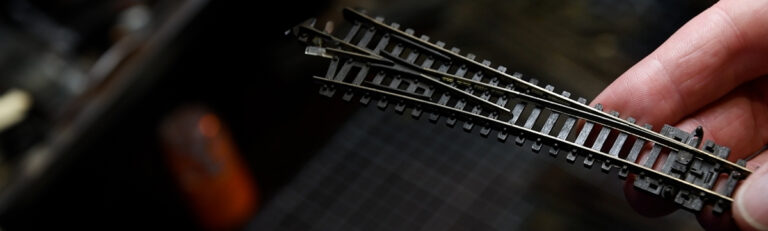
N Scale Track at 1/32

In 1 Scale, 9mm track has a rail spacing of about 1 scale foot. The ties are 2×3s with an average spacing of about 6 inches. I wanted the ties to be spaced about 12 inches apart, so I chose to remove every-other tie. This was a disaster.

Using my rail nippers, I snipped between each tie, removing every second tie as I went. Once the ties were removed the tracks seemed a little flimsy; the ties freely slid back and forth, and the rails and were quite loose. I figured that once set into the caulking everything would be fine, so I soldered the first section of track to the turnout, bent it around the curve, and disaster stuck! The entire length of rail twisted, and all the ties flew off in every direction. I attempted to snap the ties back on, but each of the little spike heads had been broken off.

I removed the twisted rails (they will make lovely scale scrap) and replaced them with another section of track ‘ ties intact. The sharp curves and steep grades put a good deal of stress on the track, but with enough pins everything held in place. I noticed another advantage of the caulking was that it still offered good adhesion in those places where the ties didn’t quite touch the baseboard.

Some areas of the track only needed an hour before they had completely dried. I took the rail nippers and removed a few ties to ensure that I could achieve the tie spacing I wanted earlier. Success!

I spent the next 10 minutes sweeping up all of the track shrapnel on the floor!


I’ve used foam for landscape contours before, and found the only drawback is that the foam is a bit flexible, so pressure on its surface can cause indents. This is no big deal – unless of course you’ve applied some plaster or spackle atop the foam, in which case it tends to flake off. With this, I chose to apply a coat of full strength white glue and paper towels to the surface of the baseboard. This offered some distinct construction advantages: First, the baseboard is now rock hard ‘ much like a plaster impregnated cloth, the glue/foam has made the surface of the baseboard virtually bullet proof. Second, I’m more confident attaching my track to this rigid surface as it will be more secure then the foam and cardboard alone. Thirdly, it’s important to seal the foam. I will be using spray-paint to colour the track etc., and I really don’t want any chemical erosion on my hillsides.

It is also now apparent that the tunnel I planned doesn’t really have the necessary clearances to look convincing. One option would be to just have one track pass over the other via a bridge, but I didn’t do much detail work on the sidewalls of the tunnel and I don’t want to excavate more material.

Time to head to the sketchbook!

Having finished (mostly finished) Pete and his speeder, I was finally able to calculate the clearances needed to construct the baseboard. The height of Pete in the engineer’s seat was just shy of 2 inches ‘ a touch higher then I would have liked as this meant that the entrance / exit to the Pumpkin Pit would need to be on a 14% grade! I reasoned that this wasn’t a terrible incline for a narrow gage railway as there are examples prototypes railways with steep inclines; the Mt. Albert Tramway in New Zealand for one.

I transferred the original layout plan to a large sheet of boxboard, and then removed the areas between the tracks to create a cookie-cutter style sub roadbed. I traced this template onto several sheets of Styrofoam and removed the areas that corresponded to the tunnel. I glued the two Styrofoam sheets to a 1/8th inch masonite panel using regular white glue, and hot-glued small pine blocks in the corners of the baseboard for facia installation. I next measured the total run of each of the grades and cut out Styrofoam ramps, which I sectioned and again fastened to the baseboard with glue. Finally, I glued the cardboard sub roadbed atop the Styrofoam with a combination of white and hot glue, and temporarily secured the entire assembly with some finishing nails.

I was surprised how quickly I managed to complete the assembly, as well as how rigid the final structure is, and how little the baseboard weighs. Next step: contouring

.


Having finished (mostly finished) Pete and his speeder, I was finally able to calculate the clearances needed to construct the baseboard. The height of Pete in the engineer’s seat was just shy of 2 inches ‘ a touch higher then I would have liked as this meant that the entrance / exit to the Pumpkin Pit would need to be on a 14% grade! I reasoned that this wasn’t a terrible incline for a narrow gage railway as there are examples prototypes railways with steep inclines; the Mt. Albert Tramway in New Zealand for one.

I transferred the original layout plan to a large sheet of boxboard, and then removed the areas between the tracks to create a cookie-cutter style sub roadbed. I traced this template onto several sheets of Styrofoam and removed the areas that corresponded to the tunnel. I glued the two Styrofoam sheets to a 1/8th inch masonite panel using regular white glue, and hot-glued small pine blocks in the corners of the baseboard for facia installation. I next measured the total run of each of the grades and cut out Styrofoam ramps, which I sectioned and again fastened to the baseboard with glue. Finally, I glued the cardboard sub roadbed atop the Styrofoam with a combination of white and hot glue, and temporarily secured the entire assembly with some finishing nails.

I was surprised how quickly I managed to complete the assembly, as well as how rigid the final structure is, and how little the baseboard weighs. Next step: contouring.

The trackplan for Pete’s Pumpkins railroad is loosely based on Chuck Yungkurth’s Gum Stump & Snowshoe model railroad ‘ a small 1′x6′ switching layout published in Model Railroader in the 60’s. The hallmark feature of the Gum Stump & Snowshoe was the switchback arrangement that allowed for the mainline to cross over itself. I decided to reverse the elevations, eliminate the sidings, and join the original east and west tracks to create a continuous loop. The finished plan bears little resemblance to the original GS&S, however the essence is still there.

In an attempt to add some plausibility to the railroad’s design, I envisioned that Pete runs a roadside vegetable stand offering pumpkins to would-be halloweeners. In order to keep up with demand, Pete installed a make-shift narrow gave railway to transport pumpkins from the neighbouring fields to his barn. As demand is high, Pete is constantly transporting goods from the barn to the roadside stand via the ‘pumpkin pit’ ‘ the underground access to the barn’s cellar.

The overall plan size is 18″x24″ ‘ just 3 square feet ‘ which easily qualifies it as a micro layout (micro layouts categorically are those model railroads that are 4 square feet or less). The elevations will undoubtedly be steep, and the curves are tight, so creative scenicing will be paramount in order to create relative believability. Likewise, pumpkin season dictates that the layout be modeled in late fall, requiring autumn colours and withering vegetation.