WGR Track


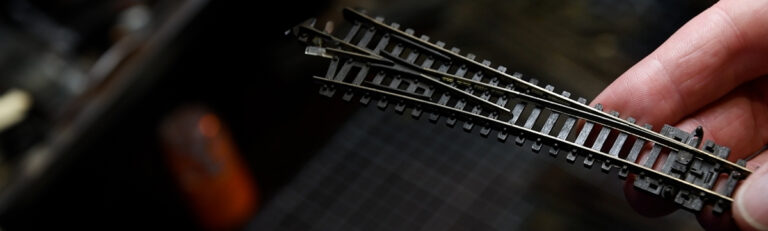
Woodland Scenic’s roadbed is too wide.

For the past year I’ve been staring at the rails on the NES, and now the WGR, trying to figure out why the track seems so crude and toy like. Originally I presumed it was because of rail size – having used code 80 on the NES. I changed rail for the WGR and the code 55 rail does make a difference, however the track still seemed to stick out like a sore thumb.

It wasn’t until I starting asking others for their opinion that someone finally pulled out a ruler and rendered a verdict. Woodland Scenic’s roadbed is between 2 and 4 scale feet too wide!

Next time you are near a level crossing, take a look at the rail, ties and roadbed and what you’ll likely notice is that the ballast falls away on a 2:1 slope just after the edge of the ties. If you compare that to the WS offering, it becomes apparent that the roadbed makes for a better 2 lane highway then track bed.

I want to make it very clear that I’m NOT trying to get too hung up on frivolous details. The WGR is not a mainline railroad, so the track should look less maintained. The same was true of the NES, however despite my best efforts, the track looked heavily traveled – due in part to the over sized roadbed.

I decided to trim the roadbed, drawing a large utility knife along the edge of the ties on a slight angle. I wasn’t too worried about getting the angle ‘just right’ as I assumed that the ballast would fall naturally and create the appropriate grading.

I trimmed a few inches of roadbed on one of the siding and added some ballast.  I’m happy with the result. What do you think? Worth the effort?

Do you prefer the narrower Wooland Scenics roadbed?

View results

Having successfully overcome the “cheap turnout control” problem, finding a solution for the “cheap electrics” problem was a snap. I decided that rather then bother purchasing toggle switches to control my electric blocks, I would use regular household switches instead.

My house is very old, and in an attempt to preserve some sense of history we’ve tried our best to ‘back-date’ modern inclusions as best we can. Once decision we made early in our renovation efforts was to keep all the switches ‘bake-o-lite brown’ – thus I had a number of brown switches on hand. The dark switches will blend in nicely with the future fascia.

The plus side of the switches is cost – roughly $1.50 each. The boxes, switches and the faceplate cost under $10. As well, they are fantastically durable.

Anyway, not a particularly revolutionary idea, but an interesting (and frugal) alternative to conventional practice

.

When I built the Niagara Escarpment System (my first N scale layout) I rushed the track and regretted the decision later. I didn’t bother to do a very satisfactory job weathering the rails – opting to give everything a quick spray of paint before ballasting.

I had been more concerned with the colour of the ties and overlooked the rails. The result was shiny rails that looked bigger then they really were – they stuck out like a sore thumb.

This time around I promised myself I would do a better job. The real kicker is that weathering rails is really simple, and only took a small part of an evening. A negligible effort for maximum result.

Weathering Rails:

I dampened a paper towel with a bit of ’3 in 1′ oil, and gave the tops of the rails a quick wipe – only barely applying a kiss of oil. The oil acts as a resist and prevents the water-based paint from sticking to the rail heads.

The first colour I applied was a dirty black – black mixed with a bit of tan. I used inexpensive craft store paints dilluted with water. The first coat of paint is intended to paint the sides of the rails, thus, you need ensure that the airbrush is aimed at a low angle just above the roadbed.

Once the first coat of paint had dried, I applied alternating coats of grey, tan and brown paint directly above the rails in order to avoid painting rail sides. This coat of paint is intended to weather the ties, so I applied the colours in a random fashion with varying intensities, until I had achieved a look I was satisfied with.

Once the paint had again dried, I gently polished the rail heads with a clean paper towel – the paint rubbed away from the railheads effortlessly – thanks to the ’3 in 1′ oil applied earlier.

As you can see in this image, the shine of the rails has been reduced signifigantly, and the colours are muted and will hopefully blend with the ballast well. The different colours used on the ties/rails are evident in the overspray.

One would think that a simple railroad like the WGR would be easy to wire – and I suppose it has been ‘easy’ job, but it certainly hasn’t been a small job! Until I actually started soldering I hadn’t taken into account how much wiring I would need to do in order to wire each frog as well as isolate each spur. It has been more then I estimated.

That being said, the job has been fairly straightforward and I’ve spent the last week leisurely completing each section. I wired the Atlas code 55 turnouts as per the manufacturers instructions – using the hidden slide switch designed to control the turnouts to power the frogs. I also isolated each spur on the pike by cutting the rails using a cutting wheel on my Dremel tool. I think I will use common light switches to control the different electrical blocks; the cost of half a dozen light switches, mounting box and face plate is worth the same as a single toggle switch from Radio Shack. I’ve seen them used once before and they looked very handsome.

I didn’t bother to create separate cabs as I won’t be running multiple consists. Naturally, I could have simplified this entire process by having simply gone to DCC…

Next steps: Once the wiring is complete, I need to weather the track, install the bridges as well as the fascia. Once that is done I’ll be able to turn my attention to scenery.

Having completed the track I was eager to try running some trains. I had been rather cavalier when I installed the track work – not bothering to test each turnout etc., in favour of simply finishing the job. As such, I was eager to get trains running and see how I did.

The verdict? I managed to do a great job! Trains run great!

Granted, I needed to clean the track, file down the odd solder blob and clean the cursed foam shavings out from under the ties, but overall the trains ran well. I was so excited I shot some video for prosperity’s sake. I still have to wire the turnouts and cut some gaps in order to isolate the sidings, but that’s straightforward work that can be done as I start thinking about how to model the concrete bridges and retaining walls.

(I also spent some time finishing the basic scenery contours, and roughing in the overpass locations.)

Progress on the WGR has been slow of late, but I’ve managed to finally finish laying the track.

As mentioned in an earlier post, the switch machine dilemma was one factor responsible for the summertime pause. However, once I was able to finalize the switch machine design, progress ramped-up considerably.

I’ve yet to wire each of the turnouts and fix-up some of the roadbed, but the track is done and initial tests suggest that everything is running smoothly.

I feel it is worth mentioning that I modified my track laying technique for the WGR. I have traditionally used clear latex caulking as a track adhesive (impressed by the adhesion and ease of use) however the process of applying adhesive before track can get rather messy when track is adjusted (in order to join ends etc.).

Shifting track once its be seated in the caulking forces caulk up between the ties – creating a annoying mess that must be cleaned up. In order to avoid this, sections of track with absolute positioning were fastened using caulk, and those sections that needed tweaking were pinned firmly in place and then covered in diluted white glue and wet-water – just as in ballasting.

I had some fears that the glue could ‘let-go’ once I start ballasting, however as I’m intent on painting the rails and ties, the track should stay in place – if by nothing more than the adhesive properties of the paint alone.

One of the challenges I’ve been trying to solve over the last few months is what to use as turnout controls on the WGR. While foam bench work offers many design advantages (ease of construction, weight etc.), its solid structure complicates installing switch machines – a practice greatly simplified in open-grid bench work designs.

I wanted to avoid the use of manual turnout controls – for appearance reasons only – so I’ve spent the last while trying to develop a cheap/reliable controller. Likewise, the isolated frogs on the A55 switches need power routing – an additional benefit of using the slide switches.

I developed my first controller using a slide switch to control the points, and a ‘choke-cable’ arrangement to activate the switch. The ‘choke-cable’ is made from small-diameter gas line tubing and aircraft cable. I assembled a temporary test switch and was happy with the results.

I refined the design further such that the controller consisted only of a slide switch epoxied to a small scrap of styrene, with the aircraft cable drilled/glued to the slide, and the point-control wire.

I installed the controllers by carefully carving a small 1” deep cavity directly beneath each turnout throw-bar, and affixing the entire assembly into position using hot clue. Each of the control lines were embedded in channels carved in the foam, and covered with very thin styrene.

I am surprised how well these controllers work. I’ve since finished the track work and the choke cables work flawlessly. Once I’ve installed the fascia, I’ll add some knobs to the ends of the controller cables.

Rather then write more on the assembly; I hope the pictures will suffice.

progresssmall.jpgSince my last post, progress has slowed significantly. Outside of the regular day to day distractions, I’ve had to do a great deal of thinking about how I will proceed with several aspects of the layout. Firstly, I’ve had to consider how I am going to control the turnouts, and I’ve been working on creating a remotely controlled switch machine using small SPST slide switches, aircraft cable and gas-line tubing. (A post to follow on this – I promise!)

Second, I’ve been deciding where to start laying track as this will dictate where I finish – I don’t want to get caught trying to make the last join on a curved grade at the throat of the yard.

Finally, I’ve been using some 1:1 paper turnouts to continually test my track configuration. I’m not entirely happy with the length of the run-around track – about 4+ cars – but operationally it doesn’t have a huge impact, and other configurations tend to undermined the overall ‘look’ I’m trying to achieve.

That being said, I have managed to install 95% of the roadbed, and started to lay some track. I opted to give the Woodland Scenics roadbed another try – despite having difficulties with it the first go ’round. The big factor here was cost – it cost me $6.00 for the foam roadbed whereas cork would have cost me $30.00, therefore, foam was the obvious choice.

I glued the foam to the baseboard using slightly thinned white glue – brushing a wide swath of glue over the centreline of the track. I pinned the roadbed in place using push-pins, and once satisfied with the positioning, a brushed some additional glue along the shoulders of the roadbed for good measure. I’m not convinced that white glue is going to offer the same adhesion strength that adhesives like PL300 provide, but I didn’t want to have to carefully smooth beads of glue with a trowel in order to get a even surface – the high viscosity of PL300 and the like require all lumps to be smoothed out, otherwise they will create bumps in the roadbed – a noticeable imperfection in n scale. Once the ballast is glued in place I’m confident things will stay put.

As for the track – my first impression of the Atlas’ Code 55 is good – nice to work with and great looking. More on that later.

progress1.jpg

progress3.jpg

progress4.jpg

progress2.jpg